Connection Settings
Choose the appropriate authentication type and provide the information required to connect and interact with the source.
-
Select an option from the Authorization Types drop-down list:
-
Simple: To use a clear-text password for the Service Account.
-
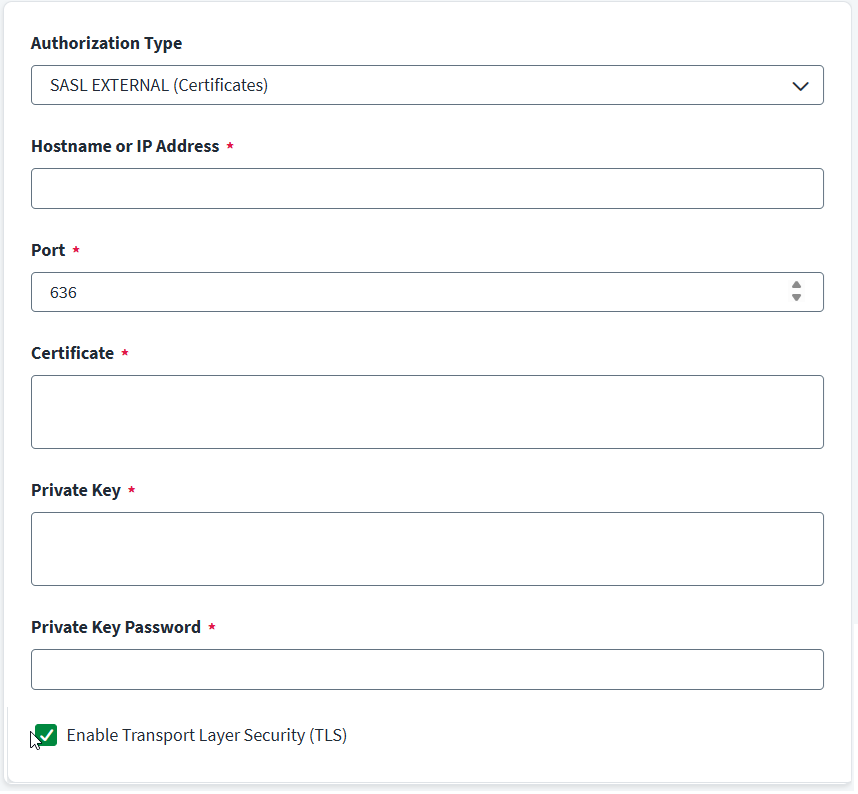
SASL EXTERNAL (Certificates): To use certificate-based secured authorization.
-
None: If you do not want to use authorization when connecting to the server.
-
-
Enter the Hostname
-
Enter the Port number that the server communicates through (the default is 389). Ensure to enter correct port number for certificate-based authorization.
-
Depending on your selection in Step 1, complete the following fields:
-
If you select Simple or None:
-
Enter the Service Account DN that points to a user in the LDAP tree who can manage the LDAP server (for example:
cn=Admin,dc=example,dc=com). -
Enter the Password for the Service Account.
-
(Optional) Select Enable Transport Layer Security (TLS) to connect securely to the server.
-
-
If you select SASL EXTERNAL (Certificates), additional fields appear:
Important
You must provide an Encrypted Private Key for certificate-based secured authorization.-
Enter the content of the client-certificate file in Certificate.
-
Enter the client’s encrypted private-key contents in Private Key.
-
Enter the passphrase password in Private Key Password to parse and decrypt the private key.
-
(Required) Select Enable Transport Layer Security (TLS) to connect securely to the server.
-
-
-
Select Save.
 Screenshot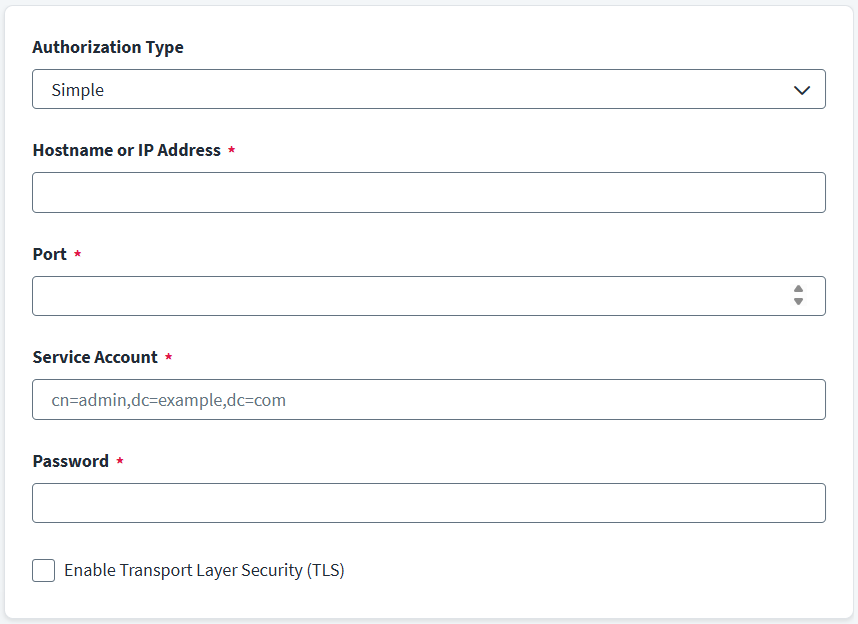
Note
For existing sources, it is mandatory to add the encrypted attribute through a
Endpoint: PATCH /v3/sources/{sourceId}
Request Body:
[
    {
        "op": "add",
        "path": "/connectorAttributes/encrypted",
        "value": "clientCertificate,privateKeyPassword,private_key"
    }
]